Stage 1: Retrieval Methods
This section covers methods for the first stage of the RAG pipeline: efficiently retrieving candidate documents from large corpora.
Stage 1 Topics:
- Sparse Retrieval Methods
- Dense Baselines & Fixed Embeddings
- Hard Negative Mining
- Late Interaction (ColBERT)
- Short Answer
- Long Answer: Why Late Interaction is Special
- The ColBERT Architecture
- ColBERT Literature
- Other Multi-Vector Methods
- How ColBERT Does Both Stages
- Performance Comparison
- When to Use ColBERT
- Implementation Example
- The Index Size Problem
- Advanced Topic: MaxSim Operation
- Comparison with Cross-Encoders
- Poly-Encoders: Another Middle Ground
- Research Directions
- Next Steps
- Hybrid Dense-Sparse Methods
- Pre-training Methods for Dense Retrievers
- Joint Learning of Retrieval and Indexing
- Literature Survey: Retrieval Methods
Introduction: From Lexical to Semantic Matching
Text retrieval aims to find relevant information resources (e.g., documents or passages) in response to a user’s natural language query. As a fundamental technique for overcoming information overload, its methodology has evolved through several distinct paradigms, as detailed in the comprehensive survey “Dense Text Retrieval based on Pretrained Language Models: A Survey” by Zhao et al. (2022).
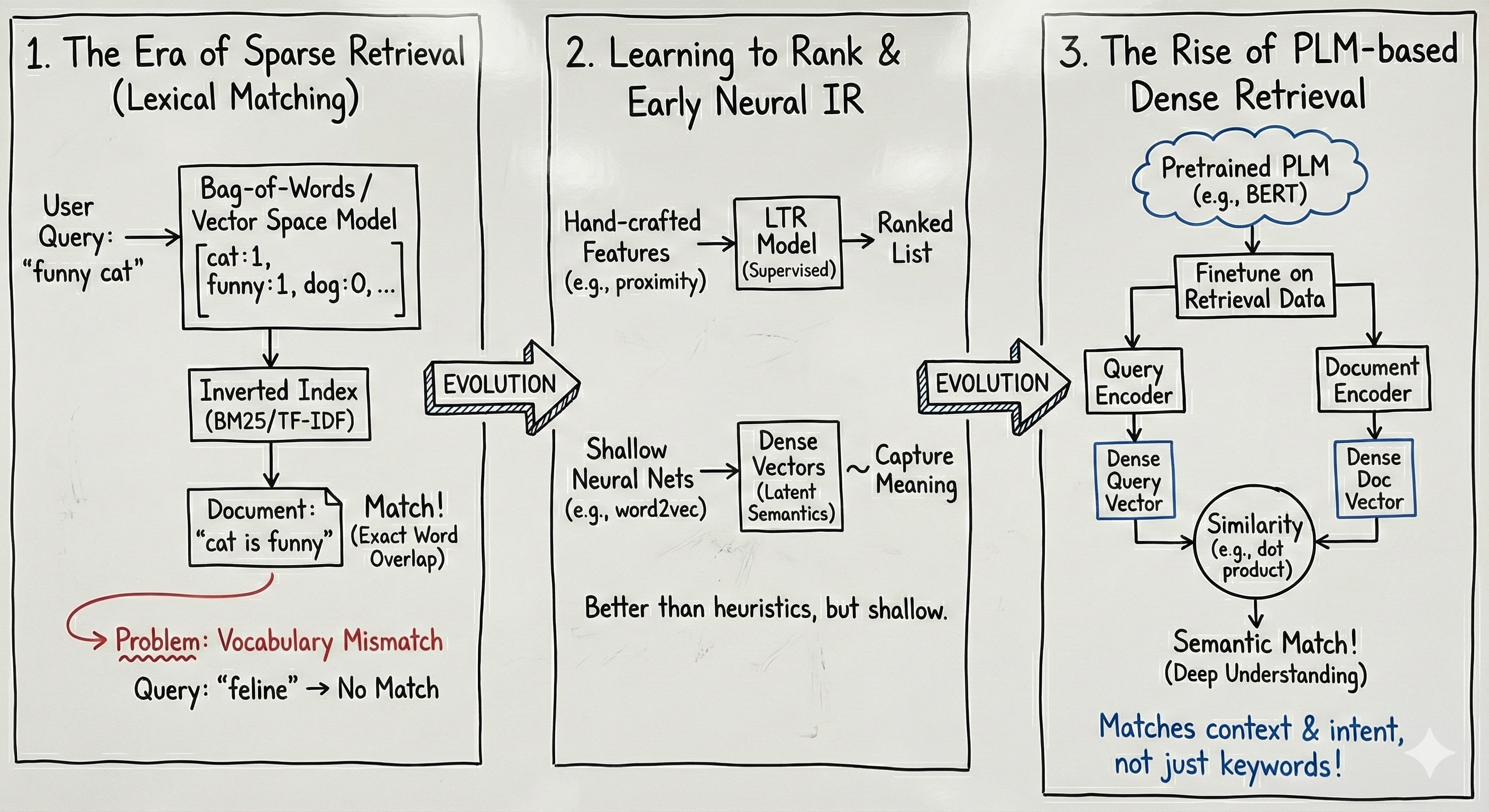
1. The Era of Sparse Retrieval (Lexical Matching)
For decades, the field was dominated by the Vector Space Model and the “bag-of-words” assumption. * Mechanism: Queries and documents are represented as sparse vectors where dimensions correspond to explicit terms (words) from the vocabulary. * Algorithms: TF-IDF and BM25 became the gold standard for estimating relevance based on lexical overlap (exact word matches). * Infrastructure: These methods are efficiently supported by Inverted Indexes, allowing for lightning-fast lookup.
While effective and explainable, these methods struggle with the vocabulary mismatch problem—failing to retrieve relevant documents that use synonyms or different phrasing than the query.
2. Learning to Rank and Early Neural IR
To move beyond simple heuristics, researchers adopted Learning to Rank (LTR), using supervised learning with hand-crafted features (e.g., query term proximity, page rank) to train ranking functions.
Subsequently, early Neural IR approaches began using shallow neural networks (e.g., word2vec) to learn low-dimensional embeddings. Unlike sparse vectors, these dense vectors aim to capture latent semantics, allowing matching based on meaning rather than just surface forms.
3. The Rise of PLM-based Dense Retrieval
The advent of Pretrained Language Models (PLMs) like BERT marked a revolutionary paradigm shift. * Deep Understanding: PLMs, pretrained on massive text corpora, encode rich semantic knowledge and context sensitivity. * The “Pretrain-then-Finetune” Paradigm: Models are first pretrained on general text, then fine-tuned on retrieval datasets (like MS MARCO or Natural Questions). * Semantic Matching: Relevance is measured by the similarity (e.g., dot product or cosine) between the dense vector representations of the query and document.
This shift enables systems to answer complex queries (e.g., “average salary for dental hygienist in nebraska”) where the answer depends on understanding intent and semantic relationships, not just keyword matching. This survey and documentation focus on this modern era of PLM-based Dense Retrieval.
Core Aspects of Modern Retrieval
We organize the study of Stage 1 retrieval into four major aspects:
1. Architecture How to design the neural networks that encode text. * Dual-Encoders: Independent encoding of query and document into single vectors (fastest, standard for dense retrieval). * Late Interaction: Preserving token-level embeddings for richer, fine-grained interaction (e.g., ColBERT). * Hybrid: Architectures that explicitly combine sparse (lexical) and dense (semantic) signals.
2. Training Strategies How to optimize the retriever effectively. * Hard Negative Mining: The critical process of identifying challenging negatives to teach the model fine-grained distinctions (see Hard Negative Mining). * Knowledge Distillation: Learning from more powerful cross-encoder teachers. * Pre-training: Tailoring the underlying PLM specifically for retrieval tasks before fine-tuning.
3. Indexing and Efficiency How to search millions of dense vectors in milliseconds. * ANN Search: Approximate Nearest Neighbor algorithms (e.g., HNSW, FAISS) used to query the dense vector space. * Learned Indexes: Optimizing the index structure end-to-end with the model.
4. Integration Building the complete retrieval pipeline, including combining multiple retrievers and optimizing the retrieval depth.